Back to ?p=7375

Depression can take a decade off your life — and that should change how we do healthcare

As part of our new Research Snapshot series, this blog highlights new evidence on the life expectancy gap for people living with mental health conditions. It shows that common mental illnesses like depression are linked to significant years of life lost, reinforcing the need to make physical healthcare a routine part of mental health care.

When people hear that “mental illness shortens lifespan”, many assume we’re talking about severe mental illnesses such as schizophrenia. There’s an uncomfortable kind of reassurance in this assumption – it allows people to think that it only affects a minority of the population.  

But a large synthesis of international research suggests that story is incomplete. 

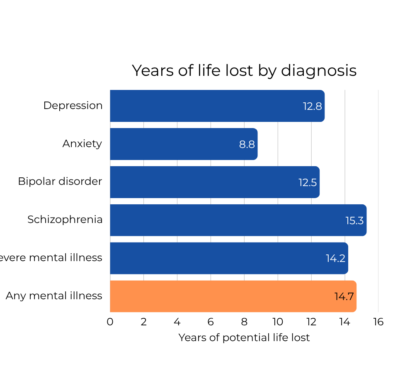
A recent systematic review and meta-analysis (Chan et al., 2023) pooled evidence from 109 cohort studies across 24 countries, covering more than 12 million people with a range of mental illnesses. Their findings were that across any mental illness people lose around 14.7 years of potential life compared with the general population.  

And for depressive disorders, the pooled estimate is about 12.8 years of life lost.  

That’s not a low prevalence diagnosis. Depression is one of the most common health conditions in the community, and the mortality gap is still substantial. Severe mental illness has a very high risk, but early mortality is a whole-of-population inequity for people with mental health challenges, and our systems need to respond accordingly.  

research snapshot
Findings and implications 

The study looked at two key measures: (1) Life expectancy (how long people are expected to live), and (2) Years of potential life lost (YPLL) (how many years earlier people die than expected)  

Across all mental disorders combined, the pooled life expectancy was about 63.9 years, with a pooled YPLL of 14.7 years. There was a clear gradient when they disaggregated by diagnosis, with more severe conditions being related with a greater health disparity. But even disorders that people often label as ‘milder’, like many anxiety-related conditions, were still linked to almost a decade of potential life lost.  

Deaths by suicide contribute heavily to early mortality because they tend to occur young, but they account for only a minority of deaths overall. The bulk of excess deaths are from preventable chronic conditions such as cardiovascular diseases – which this study terms “natural” deaths – somewhat of an oxymoron given that a 10+ year shortened life expectancy caused by inequitable healthcare access is quite unnatural 

These preventable conditions not only cut people’s lives short but can reduce the quality of their lives, impacting the ability to enjoy the same opportunities as those without these conditions.  

Healthcare systems treat mental health and physical health as two parallel tracks. Mental health services focus on distress, safety, and symptom reduction. Physical health services focus on diabetes checks, cancer screening, and vaccinations. But this study clearly links a spectrum of mental illnesses with inequitable health outcomes, highlighting what happens when a whole system consistently under-delivers equitable physical healthcare to people with mental illness.  

A mental health diagnosis should trigger the same kind of proactive preventative medical response we’d expect for other risk factors, like smoking, diabetes risk, or family history of heart disease. 

EW Research Series #1 Chan Graph
Recommendations 

This study adds weight to something that advocates have been saying for years: the life expectancy gap associated with mental illness is real, large, and persistent. Physical health prevention should be default for anyone receiving mental health care in primary care, community services, hospitals, and psychosocial support settings.  

Relevant actions from Equally Well’s Call to Action include: 

1) Make physical healthcare routine wherever mental health care happens  

Integrate screening and early intervention programs (including for cancer screening, immunisation, smoking cessation, cardiovascular disease and diabetes) with mental health services. 

Warm referrals (not just advice) to GPs, chronic disease nurses, smoking cessation supports, dietitians and exercise physiology where available. 

Commissioned shared-care models and asynchronous case conferencing so people don’t have to coordinate complex systems alone. 

2) Build accountability: measure what matters and embed lived experience leadership 

Embedding lived experience roles at all levels of system re-design can ensure that a human-rights lens underpins reform for health equity.  

Workforce training and co-produced service redesign across mental health, primary care and specialist settings can reduce diagnostic overshadowing and improve access pathways. 

Measuring and reporting on KPIs related to closing this health gap can instil accountability and incentivise action.  


Source:
Chang, W. C. (2023). Life expectancy and years of potential life lost in people with mental disorders: a systematic review and meta-analysis. EClinicalMedicine, 65.  


Download the Factsheet
Screenshot 2026-06-09 at 15.52.44