Back to ?p=7460

Bowel screening saves lives – but only 1 in 4 people access it

Join the movement for health equity, starting with bowel movements.
Don’t ignore the motion that could save your life – your bowel motion.

Our new Research Snapshot series continues, and this blog brings attention to inequities in Australia’s National Bowel Cancer Screening Program. People living with severe mental illness are less likely to complete bowel screening and follow-up care, even though screening may be especially important for this group. The findings point to a clear need for prevention programs that are not just universal, but actively supported and accessible for everyone.

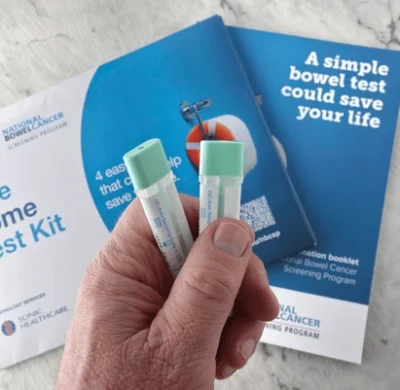
Australia’s National Bowel Cancer Screening Program (NBCSP) is often held up as an exemplar population-wide prevention strategy, saving lives through early detection of bowel cancer.  It’s simple – a free kit in the mail, collect a sample at home, send it back, and receive the result. But if we examine the pathway more closely, national data show that this universal health program isn’t equally accessible for everyone.

A large national data linkage study of more than 1.2 million Australians found that people with severe mental illness (SMI) are less likely to complete the first step of returning the test kit. About 25% of people with SMI returned their sample compared to 37% of those without. Further, people with SMI were less likely to have a valid test, suggesting they had difficulties with following instructions to collect the sample.

That’s the first drop-off. What makes the findings more alarming is that among those who returned a test, people with SMI were twice as likely to receive a positive result. In other words, the group least likely to screen is the same group for whom screening is most needed. This potentially reflects a substantial loss of life given that survival rates for bowel cancer are more than 90% if detected early.

That’s not just a gap – it’s a systemic failure.

research snapshot

But screening is only the first step. If a test comes back positive, a follow-up colonoscopy is critical to confirm a diagnosis and initiate care. And here, the pathway breaks again. After a positive result, people with SMI were less likely to undergo follow-up colonoscopy: 72% compared to 83% in those without.

It’s a pathway problem, with drop-offs at each step from the bowel motion to the biopsy.

The NBCSP relies on people receiving and opening mail, understanding instructions, completing a stool sample correctly, posting it back, reading and understanding results, and navigating follow-up appointments. These steps are manageable for many people, but they can be significant barriers for others.

The authors of the study suggest a range of possible contributors to this disparity: differences in access to care, competing priorities, and lack of continuity of care. Prior traumatic experiences with health services and anticipatory anxiety related to procedures like colonoscopy can lead to avoidance of screening programs. And there are structural barriers such as socioeconomic disadvantage and discrimination which leads to people’s physical health being de-prioritised.

perth-western-australia-may-2-600nw-2775557103

This study puts the spotlight on Australia’s NBCSP as a diagnostic tool – not for bowel cancer, but for the health system itself, and the diagnosis is ‘inequity’.

Inequity can be built into even well-designed, universal programs – not through intent, but through assumptions about how people engage with care. Here’s some ideas for how we can improve the prognosis:

  • Provide screening kits through mental health services, not just by mail
  • Offer dedicated follow-up support, including help navigating colonoscopy
  • Embed screening into routine care rather than leaving it as an individual task

These aren’t radical changes, they’re modest system adjustments that recognise something fundamental: prevention works best when it’s proactive not passive.

If the movement for health equity is about making systems work for everyone, then bowel screening offers a very tangible place to start, because sometimes the difference really does come down to a single bowel movement.


Source:
Kisely, S., et al. Participation in the National Bowel Cancer Screening Program by people with severe mental illness, Australia, 2006–2019: a national data linkage study, MJA, 2024


Download the Factsheet
images (5)